
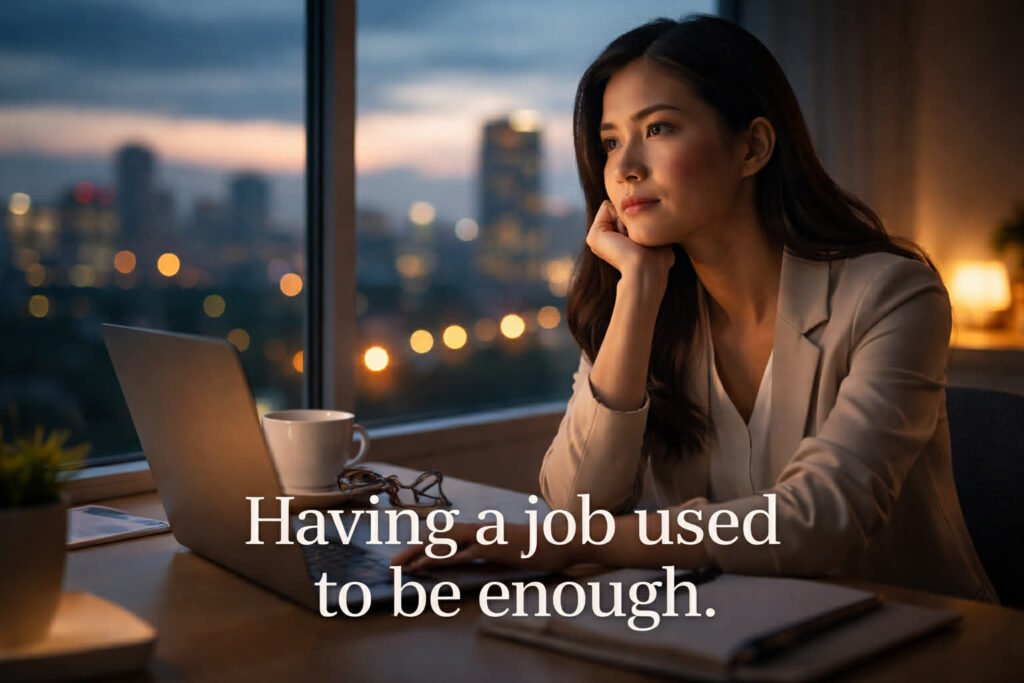
Why Having a Job Is No Longer Enough
For a long time, having a job meant security.
It meant you were doing something right—earning an income, supporting your family, and moving forward. For many Filipinos, being employed felt like the foundation of a stable life.
Today, that foundation feels less certain.
Many Filipinos are working harder than ever, yet living with a quiet sense of unease. Contracts are shorter. Costs rise faster than salaries. Work demands more time and energy, often at the expense of health. Families rely on one income, leaving little room for error. One unexpected event—an illness, a layoff, a family emergency—can unravel years of effort.
These realities don’t mean people are failing. They reflect how the nature of work has changed.
A career is not just a job title or a position on paper. It is your ability to earn consistently over time. It supports your household, funds your responsibilities, and gives shape to your plans. When that ability is disrupted, the impact goes far beyond the workplace.
For years, career conversations focused almost entirely on growth—promotions, pay increases, and new opportunities. Growth still matters. But it is only part of the picture. The other part is continuity: what allows your career to keep going when life doesn’t go as planned.
This is where many Filipino workers feel unprepared. Hard work alone no longer guarantees stability. Employment, while important, is not the same as security.
Acknowledging this isn’t pessimism. It’s awareness. It’s recognizing that careers deserve not just ambition, but foresight.
Because in today’s world, building a career isn’t only about moving forward—it’s also about staying standing when life interrupts.
The Quiet Shift in What “Stable” Means
There was a time when stability meant staying in one job for many years. Loyalty was rewarded with tenure, predictable income, and a sense of permanence. Today, even long-serving employees feel the ground shift beneath them. Organizational changes, evolving technologies, and budget constraints affect roles in ways that are often beyond an individual’s control.
Stability is no longer defined by how long you stay in a job. It is defined by how prepared you are when circumstances change.
This shift is subtle, but powerful. Many people still operate with old assumptions in a new reality. They work diligently, fulfill their duties, and trust that employment alone will carry them through. But modern work environments require a different kind of thinking—one that considers not only how to grow a career, but how to safeguard it.
When One Income Carries Too Much Weight
In many Filipino households, a single income supports multiple responsibilities: daily expenses, education, loans, extended family support, and long-term goals. This setup leaves very little margin for disruption.
The pressure is not always visible. On paper, everything seems manageable. But when that one source of income is interrupted, the strain becomes immediate and overwhelming.
This is not a reflection of poor planning. It is the reality of rising living costs and increasing obligations. It shows how fragile financial stability can be when it depends entirely on continuous employment.
Hard Work Is Not the Same as Protection
Filipinos are known for dedication and resilience. Many believe that as long as they work hard and do their best, things will fall into place. While hard work remains essential, it no longer guarantees protection from life’s uncertainties.
Illness does not consider work ethic. Emergencies do not wait for convenient timing. Organizational changes do not account for personal readiness.
Protection requires intention. It requires recognizing that earning ability is an asset that needs to be safeguarded, just like any other valuable part of life.
Rethinking What It Means to Build a Career
Building a career used to mean climbing upward—aiming for higher positions and better pay. Today, building a career also means building resilience around it.
It means asking different questions:
- What happens to my family’s finances if I cannot work for several months?
- How long can we sustain our needs without my income?
- Do I have systems in place that allow my career to recover after an interruption?
These questions are not signs of fear. They are signs of maturity in how we approach our professional lives.
From Awareness to Action
Realizing that a job is not enough is the first step. The next step is deciding what to do with that awareness.
Some people explore additional income streams. Others invest in skills that make them adaptable. Many begin to look into ways to protect their earning capacity through savings, planning, and appropriate financial coverage.
What matters is not the specific path, but the recognition that employment should be supported by preparation.
A More Complete View of Security
Security today is no longer just about being employed. It is about being prepared, adaptable, and protected. It is about ensuring that the career you are working so hard to build can withstand life’s inevitable disruptions.
This perspective does not diminish the value of a job. Instead, it gives it the support it deserves.
Because in today’s reality, a job is the starting point—not the full solution.
And when we talk about careers, we must also talk about how they are sustained, protected, and strengthened for the long term.
Career Matters exists to explore these realities honestly. And as we talk about careers, we must also talk about how they’re protected—because the careers we work hard to build deserve thoughtful coverage, too.
If this resonates with you, you’re not alone—and this is exactly the conversation Career Matters hopes to keep having.
Subscribe to stay connected.
From time to time, you’ll receive practical insights, thoughtful reflections, and useful guidance on building not just a meaningful career, but a protected one. Because understanding how careers work today is the first step to making them last.
Leave a Reply